



If you manage out-of-network billing for a specialty practice, you already know the “IDR” acronym. What you may not know is exactly when each deadline triggers, what documentation actually moves an arbitrator, or how the 2026 IDR Operations Final Rule changed the economics of filing. Missing a single deadline in the NSA IDR process forfeits the dispute entirely. Understanding the IDR process and its requirements turns IDR into a reliable revenue recovery mechanism.
This post walks through the complete IDR process under the No Surprises Act from the moment a payor processes a claim to the day payment arrives, including what changed under the new final rule, and what separates providers who win arbitration from those who do not.
What the NSA IDR process is
The No Surprises Act (NSA), effective January 1, 2022, was created to protect patients from "surprise" medical bills. This federal law also established a federal arbitration process that gives out-of-network providers a formal path to dispute inadequate payor reimbursements for claims that fall under the NSA, without billing patients for the difference. Under the IDR process, a neutral Certified IDR Entity (IDRE) reviews the final payment offers from both the provider and the payor and selects one as the binding outcome. There is no negotiated middle ground. One offer wins in full.
Who can initiate IDR
Not every out-of-network claim is eligible. The NSA covers three claim categories: emergency services furnished by out-of-network providers or facilities, non-emergency services delivered at in-network facilities where the patient had no meaningful choice of provider (such as anesthesiology, radiology, or pathology), and air ambulance transport provided by an out-of-network provider. Ground ambulance, elective out-of-network care, and situations where the patient signed a valid consent-and-cost-estimate-form are excluded.
The NSA IDR process: stage by stage
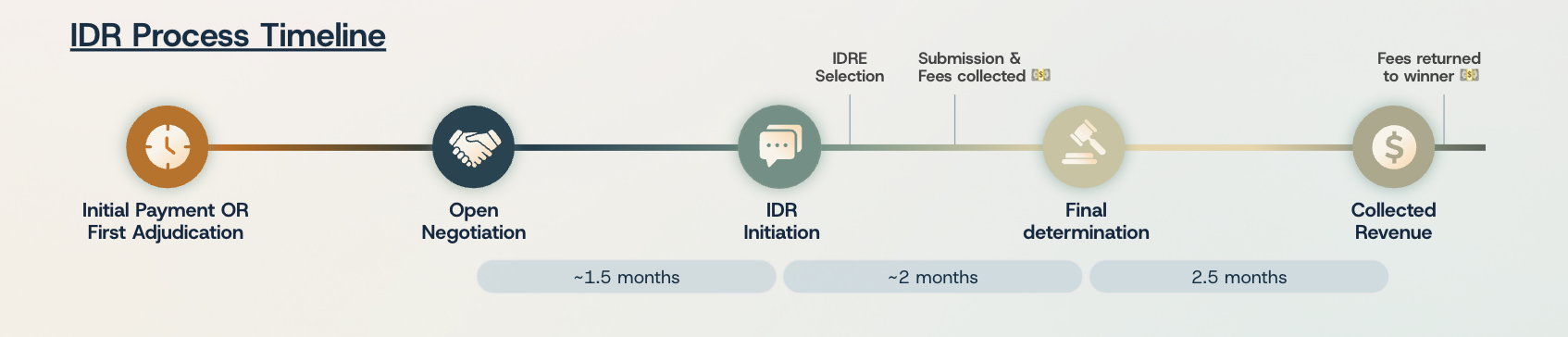
The IDR process moves through five defined stages. Each has regulatory deadlines, and providers who miss them lose the right to dispute. Here is what happens at each stage and what you need to do to protect your position.
Before the timeline starts, every claim needs a routing determination. Depending on the patient's plan type, an out-of-network dispute may be eligible for federal IDR, subject to state arbitration if the state has its own surprise billing law, or ineligible for either process. That determination hinges primarily on the plan's funding type: self-funded ERISA plans fall under federal IDR, while fully insured commercial plans may fall under a state process. The challenge is that the funding type is rarely visible in standard claim data. It does not appear on the EOB, and payors are not always forthcoming about it. Misrouting a claim to federal IDR when state arbitration applies, or filing on an ineligible claim altogether, wastes time and forfeits potential recovery. This is one of the most common friction points providers encounter, and where purpose-built technology that detects funding type at the claim level delivers real operational value. The 2026 IDR Operations Final Rule also addresses this directly by requiring the funding type to be more clearly disclosed in plan documentation at some point in the future.
Stage 1: Initial payment or first adjudication
The clock starts the moment a payor issues an initial payment or explanation of benefits (EOB) on an out-of-network claim. According to CMS guidelines, providers have 30 business days from receipt of that initial payment to initiate open negotiation. After that window closes, the right to dispute is gone.
This is where high-volume practices tend to run into the most operational difficulty. The rule is simple. However, applying it across hundreds or thousands of claims simultaneously, each with its own trigger date, requires intelligent software that tracks deadlines at the individual claim level. A spreadsheet or manual review process will often fail at scale.
Stage 2: Open negotiation
Before any IDR dispute can be filed, federal law requires providers and payors to attempt open negotiation. The provider initiates by notifying the payor, which opens a 30-business-day negotiation window – approximately 1.5 months. Either party can propose a settlement offer at any point during this period. If no agreement is reached and the window closes, the provider has a narrow 4-business-day window to escalate to formal arbitration.
Open negotiation is not a formality to get through. The documentation you develop during this stage, including patient acuity, provider experience, market rate data, and the history of your good-faith efforts to reach an in-network agreement, directly anchors your IDR submission if negotiation fails. Providers who treat open negotiation as a pre-IDR warm-up and start building their evidence file during this period are better positioned than those who begin documentation preparation after escalation.
Some payors will settle during open negotiation, particularly on clear-cut cases or when the provider has a credible filing history. Others will let the window expire by default, treating the 30 business days as a procedural formality rather than a genuine resolution opportunity. Either way, the preparation you do here determines the quality of your IDR submission if escalation becomes necessary. When the negotiation window closes, the next deadline is four business days away, and there is no buffer for documentation work that should have started earlier.
Stage 3: IDR initiation
When open negotiation closes without resolution, the provider has exactly 4 business days to initiate an IDR dispute through the federal IDR portal. This is one of the most consequential deadlines in the process and one of the easiest to miss if no system is tracking it.
Once a dispute is filed, both parties have 3 business days to jointly select a Certified IDR Entity from the CMS-approved IDRE list. If the parties cannot agree, CMS assigns one at random.
After IDRE selection, both parties pay the administrative fee. The 2026 IDR Operations Final Rule reduced this fee significantly, from $115 to $15 per dispute, which changes the ROI calculus for lower-value claims that previously sat below the cost-effectiveness threshold. Each party then submits its final offer along with supporting documentation. The IDRE does not set its own amount or negotiate a compromise. Under the baseball-style arbitration model, it selects one offer in full, and that selection becomes the binding payment.
Stage 4: Final determination
Once both offers are submitted, the IDRE has 30 business days to issue a determination. In practice, this stage spans approximately two months when you account for documentation review, any requests for additional information, and the IDRE's deliberation period.
The arbitrator must begin its analysis from the Qualifying Payment Amount (QPA), which is the payor's median in-network rate for the same service in the same geographic area. The QPA is the starting point, not the ceiling. Providers who submit well-documented evidence of appropriate payment above the QPA, citing patient acuity, provider training and experience, and local market conditions, regularly secure determinations above the QPA. According to CMS outcome data reviewed in IDR Results 2025, arbitrators across hospital-based specialties selected provider offers at rates that frequently exceeded the QPA, particularly in emergency medicine, anesthesiology, and radiology.
What arbitrators cannot consider is equally important: billed charges, usual-and-customary rates, and Medicare or Medicaid payment levels are all explicitly prohibited as factors. Providers who mistakenly anchor their offers to billed charges without building a QPA-relative case are leaving the outcome to chance.
Strong submissions include a clear explanation of why the provider's offer better reflects the appropriate payment amount given the statutory factors, supported by specific evidence rather than general assertions. Practices with a documented approach or sophisticated IDR technology, with a track record of consistently gathering and analyzing supporting data, tend to drive better results over time as they enable use of data-driven insights about what different IDREs respond to.
The determination is binding. Neither party can appeal solely on the basis of disagreeing with the outcome.
Stage 5: Collected revenue
Once the IDRE issues its determination, the losing party has 30 calendar days to remit payment. The winning party also receives a refund of the $15 administrative fee. From initial payment through final collection, the full cycle typically spans four to six months in practice, depending on IDRE capacity and claim complexity.
For specialty practices in emergency medicine, anesthesiology, or radiology, where out-of-network volumes are highest, and the disputes involve recurring claim types, this timeline has real implications for cash flow forecasting and IDR program planning.
Batching: The key to IDR at scale
Running individual disputes for every eligible claim is operationally unsustainable at any meaningful volume. Batching, which groups similar claims with the same payor into a single dispute, is how high-volume practices make IDR cost-effective.
The 2026 IDR Operations Final Rule increased the batch size limit from 25 to 50 line items per dispute and adopted a more flexible interpretation of the "similar condition" requirement, allowing groups of comparable CPT codes from the same specialty to qualify even when they span different coding terminologies or a single patient encounter. For practices that had previously avoided IDR because per-claim economics were marginal, these changes meaningfully improve the math.
The rule also reduced the cooling-off period for batched claims from 90 days to 30 days. This is the mandatory wait time after a determination before filing additional disputes for the same payor and service category. Cutting that period by two-thirds for batched claims substantially improves throughput for practices managing ongoing dispute pipelines.
How Pivotal Health helps
Managing the NSA IDR process manually, across high claim volumes, multiple payor relationships, and a regulatory environment that continues to materially change, creates compounding operational risk. Missed deadlines, under-documented submissions, and poor batch strategy are the primary reasons providers leave recoverable revenue on the table.
Pivotal Health is an IDR SaaS platform built specifically for specialty practices and health systems. The platform automates deadline tracking, identifies eligible disputes, batches strategically, and generates arbitration submissions backed by deep IDR expertise, historical claims data, and consistent documentation standards. Every client works directly with a dedicated client success manager who provides hands-on support from day one of the implementation process and then going forward.
Hospitals and health systems, as well as practices across emergency medicine, anesthesiology, radiology, and more, use Pivotal to recover revenue that would otherwise be overlooked, without adding headcount to manage a process that grows more complex every year.
Estimate your IDR recovery opportunity
If you want a more detailed assessment of your current eligibility rate, dispute strategy, and revenue gap, request a free demo and assessment. A member of the Pivotal team will review your specific situation and identify where the process is working and where it is not.